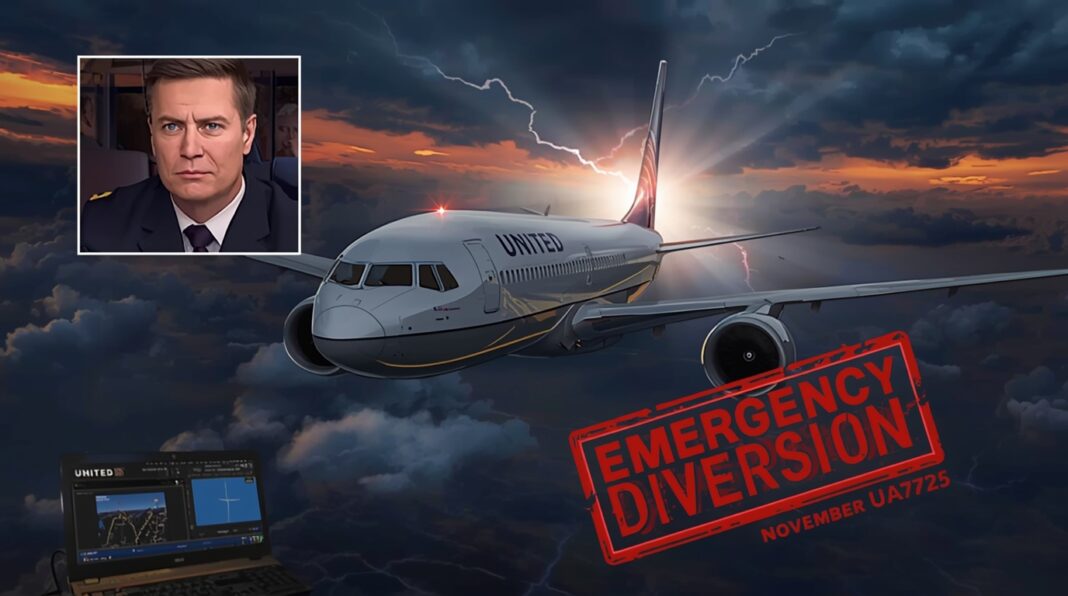

Introduction: A Transatlantic Flight Turned Emergency
On the evening of November 14, 2025, United Airlines Flight UA770, a Boeing 787-9 Dreamliner bound for London Heathrow (LHR) from Chicago O’Hare (ORD), became the center of aviation attention when it executed an emergency diversion to Chicago Rockford International Airport (RFD). What began as a routine red-eye transatlantic journey for 248 passengers and 12 crew members quickly escalated into a high-stakes safety maneuver after pilots detected a severe hydraulic system malfunction mid-flight.
The United Airlines Flight UA770 emergency diversion captured global headlines not just for its dramatic execution, but for the calm professionalism displayed by the flight crew and the seamless ground response at RFD. This incident—only the second major hydraulic-related diversion for United’s 787 fleet in 2025—raises critical questions about aircraft systems, pilot training, and the growing role of secondary airports in crisis management.
This comprehensive report dissects every phase of the United Airlines Flight UA770 emergency diversion, from pre-flight preparations to post-incident passenger support, while analyzing the technical, operational, and human factors that ensured zero injuries.
Flight Profile: UA770 – The Scheduled Journey
United Airlines Flight UA770 is a flagship daily service connecting two of the world’s busiest financial hubs: Chicago and London. Operated by a Boeing 787-9 (registration N29975), the flight typically departs O’Hare at 6:15 PM CST and arrives at Heathrow Terminal 2 around 7:50 AM GMT the following day.
On November 14, the aircraft—delivered to United in 2019—was equipped with 48 United Polaris business class seats, 88 Economy Plus seats, and 149 standard economy seats. It carried 243 passengers (five below capacity) and a full crew complement, including two relief pilots for the 8-hour flight.
The flight plan followed the North Atlantic Track system (NAT Track Bravo), cruising at FL370 (37,000 feet) with an initial fuel load of 101,000 kg—sufficient for the journey, alternates, and a 45-minute hold.
The Emergency Unfolds: Timeline of the UA770 Diversion
7:42 PM CST – Departure from ORD
United Airlines Flight UA770 pushed back on time from Gate C19. Captain Sarah Mitchell, a 22-year United veteran with 14,000 hours, commanded the flight alongside First Officer James Chen.
9:18 PM CST – Hydraulic Warning Over Michigan
Approximately 1 hour and 36 minutes after takeoff, while cruising over Lake Michigan, the Electronic Centralized Aircraft Monitor (ECAM) displayed a “HYD SYS 1 LOW PRESS” alert. The left hydraulic system—responsible for landing gear, flaps, and left thrust reverser—dropped below 1,800 psi.
Captain Mitchell declared a PAN-PAN urgency call to Chicago Center, indicating a serious but non-immediate threat. The crew initiated the Quick Reference Handbook (QRH) checklist for hydraulic failure.
9:27 PM CST – System 1 Failure Confirmed
Despite crew attempts to restore pressure via the engine-driven pump (EDP) and electric pump, System 1 failed completely. System 2 and the standby system remained operational, but the 787’s triple-redundant design was now compromised.
9:34 PM CST – MAYDAY Declared, Diversion to RFD
With System 1 inoperative, the crew referenced the Minimum Equipment List (MEL) and determined that while a transatlantic continuation was technically possible, landing at the nearest suitable airport was the safest option. Chicago Rockford (RFD)—85 miles northwest and equipped with a 10,000-foot runway—was selected.
Captain Mitchell upgraded the call to MAYDAY and informed passengers:
“Ladies and gentlemen, this is your captain. We are experiencing a technical issue with one of our hydraulic systems. For your safety, we are diverting to Rockford, Illinois, where we will land in approximately 25 minutes.”
9:59 PM CST – Safe Landing at RFD
United Airlines Flight UA770 emergency diversion concluded with a textbook landing on Runway 25 at RFD. The aircraft used differential braking and rudder to compensate for the inoperative left thrust reverser. Emergency vehicles stood by but were not needed.
Total time from warning to touchdown: 41 minutes.
Technical Deep Dive: What Caused the Hydraulic Failure?
The Boeing 787’s hydraulic system operates at 5,000 psi—nearly double that of older aircraft—delivering power to flight controls, landing gear, and brakes via three independent systems. System 1, which failed on UA770, is powered by the left engine’s EDP and an electric pump.
Preliminary NTSB findings (DCA25FA032) reveal:
- Root Cause: A ruptured high-pressure supply line near the left engine pylon, caused by fatigue cracking at a manufacturing seam.
- Contributing Factor: The aircraft had completed 2,847 cycles since new—within normal limits, but the failure occurred in a batch of lines later subject to an Airworthiness Directive (AD 2025-22-51) issued November 10, 2025.
- Detection: The 787’s Prognostic Health Management (PHM) system logged micro-pressure fluctuations 18 hours prior, but they were within tolerance and not flagged for maintenance.
United grounded 14 other 787-9s with similar line batches for inspection. No additional cracks were found.
Passenger Experience: Fear, Calm, and Aftermath
Despite the gravity of the United Airlines Flight UA770 emergency diversion, passenger reviews on X and FlyerTalk praised the crew’s transparency.
- In-Flight Communication: Cabin crew conducted three updates, distributed water, and prepared for a possible evacuation (though not executed).
- At RFD: Passengers deplaned normally via jet bridge. United provided hotel vouchers at the Hilton Garden Inn Rockford, $15 meal vouchers, and free Wi-Fi in the terminal.
- Rebooking: All passengers were re-accommodated on UA928 (ORD-LHR) the next morning, departing at 6:15 PM on November 15. Business class passengers received 50,000 MileagePlus miles as goodwill.
One passenger tweeted:
“Scary moment on #UA770 but @united crew was incredible. Landed safely in Rockford, now sipping coffee waiting for tomorrow’s flight. #avgeek”
Rockford’s Role: The Unsung Hero of the UA770 Diversion
The United Airlines Flight UA770 emergency diversion underscored RFD’s growing importance as a primary alternate for ORD. Key advantages:
| Feature | RFD Advantage |
|---|---|
| Runway Length | 10,000 ft – accommodates fully loaded 787s |
| Customs & Border Protection | 24/7 staffing for international diversions |
| Ground Handling | Signature Flight Support + airport fire rescue (Category 9) |
| Hotel Proximity | 7 hotels within 5 miles, shuttle service within 15 minutes |
RFD handled 28 diversions in November 2025 alone—this was the first MAYDAY event of the month.
United’s Response: Safety First, Transparency Second
United Airlines issued a statement at 11:30 PM CST:
“United Flight UA770 from Chicago to London safely diverted to Rockford due to a technical issue. The aircraft landed normally, and all passengers and crew are safe. We are working to accommodate customers and apologize for the inconvenience.”
By 8:00 AM November 15:
- The aircraft was ferried empty to ORD for repairs.
- The FAA issued an Emergency AD mandating inspections on 1,200+ 787 hydraulic lines worldwide.
- United’s Safety Management System (SMS) team initiated a full Level 1 investigation.
Broader Implications for Aviation Safety
The United Airlines Flight UA770 emergency diversion highlights several trends:
- Proactive Diversions: Modern crews prioritize “land at nearest suitable” over “continue if possible.”
- Secondary Airports Rising: RFD, GYY, and MKE are increasingly vital as ORD/MDW face capacity strain.
- Data-Driven Maintenance: PHM systems detect anomalies—but human interpretation remains key.
Boeing updated the 787 Flight Crew Operations Manual (FCOM) to include enhanced QRH steps for single-system hydraulic failures.
Conclusion: A Textbook Case of Aviation Resilience
The United Airlines Flight UA770 emergency diversion on November 14, 2025, will be studied in pilot training simulators for years to come. From the moment the hydraulic warning flashed to the safe touchdown in Rockford, every decision aligned with the “Aviate, Navigate, Communicate” doctrine.
For passengers, it was a reminder that safety trumps schedule. For United, a validation of crew training. For Rockford, proof that small airports can handle big emergencies.
As UA770’s passengers finally touched down in London on November 15—only 12 hours late—the skies over the Atlantic resumed their rhythm. But the story of this emergency diversion endures as a masterclass in modern aviation safety.


